
Technology
Four advances, each removing one obstacle to the alkali laser
The result is a rubidium laser that runs at low pressure, on the unshifted atomic line, and delivers its energy in pulses.
Where we started
The diode-pumped alkali laser has intrinsic advantages over solid-state lasers, and a set of well-known obstacles that have kept it from realizing them. Both are set out under Why DPAL. The four advances below are listed in the order we made them. Each answers one of those obstacles.
1. A pump locked by the atoms themselves
The obstacle. Diodes are about a thousand times wider in wavelength than the line they must pump. Diffractive narrowing recovers a factor of ten, and high pressure has had to make up the rest.
We place a Faraday anomalous-dispersion optical filter inside the external cavity of the diode stack. The filter is a warm rubidium cell in a magnetic field between crossed polarizers. Only light at the atomic line passes it and returns to the diodes. That feedback locks every emitter to the rubidium D2 line and narrows the pump to a few gigahertz (U.S. Patents 10,348,057 and 12,470,039). The lock holds through thermal and drive variations. Modules of roughly one kilowatt per stack have been demonstrated.
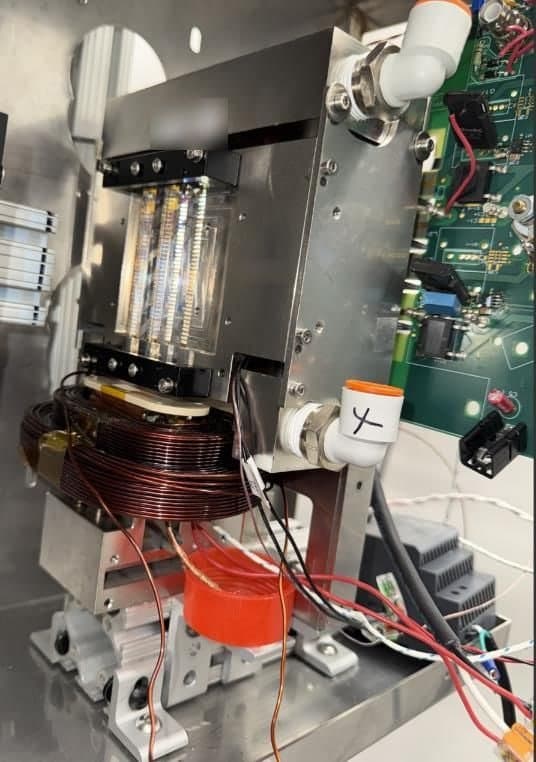

With the pump this narrow, the laser no longer needs high pressure. The amplifier runs near a quarter of an atmosphere. There the absorption is strong, so the cell runs cooler and less dense, and the loss processes fall to near their intrinsic limit. The output returns to the vacuum wavelength of the rubidium line, which the atmosphere transmits well, and it matches an atomic-line filter at the receiver.
Reference: AMOS 2025 paper and SPIE 2026 invited paper (in press), listed under Publications.
2. A ring resonator with its return path exposed
The obstacle. In a two-mirror resonator the light forms a standing wave, and every element that controls it sits in the full-power beam.
We converted an unstable resonator into an unstable ring. The light travels one way around. The weak portion that is fed back to begin each round trip travels on a path of its own, apart from the high-power beam. On that low-power return path we place the elements that shape the transverse mode, set the polarization, and form the pulse.
Pulsed lasing was first obtained in this ring.
Reference: SPIE 2026 invited paper (in press), listed under Publications.
3. A folded path that stores energy in the light
The obstacle. An excited alkali atom holds its energy for about thirty nanoseconds. The medium cannot store energy between pulses, so alkali lasers have been continuous-wave machines.
A folded multipass path returns a single pulse through the amplifier many times. The pulse is as long as one trip out and back, so the amplifier always has light in it and gives up its pump energy continuously, all of it into that one circulating pulse. The energy accumulates in the light instead of in the atoms, and the pulse energy rises with the number of passes.
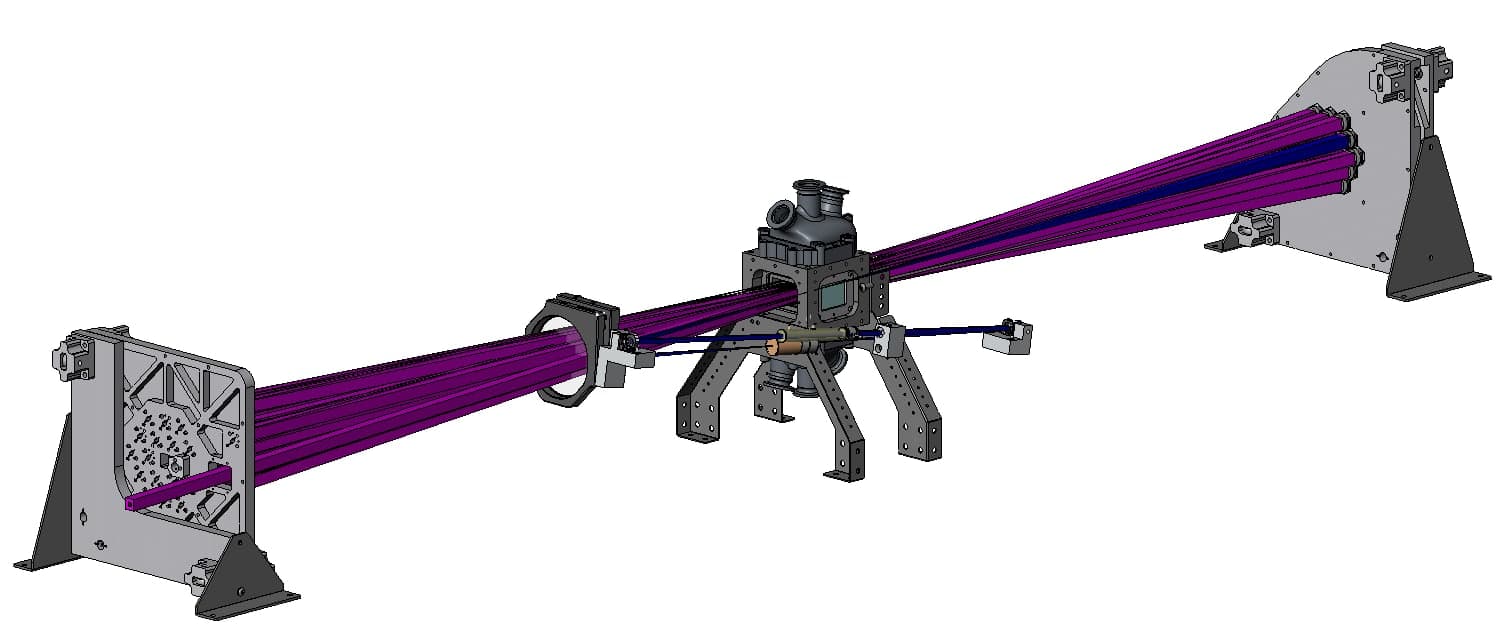
A multipass prototype operated for months, and a larger resonator has reached first light in a limited configuration. The prototypes produce nanosecond pulses at peak powers far above the equivalent continuous-wave output.
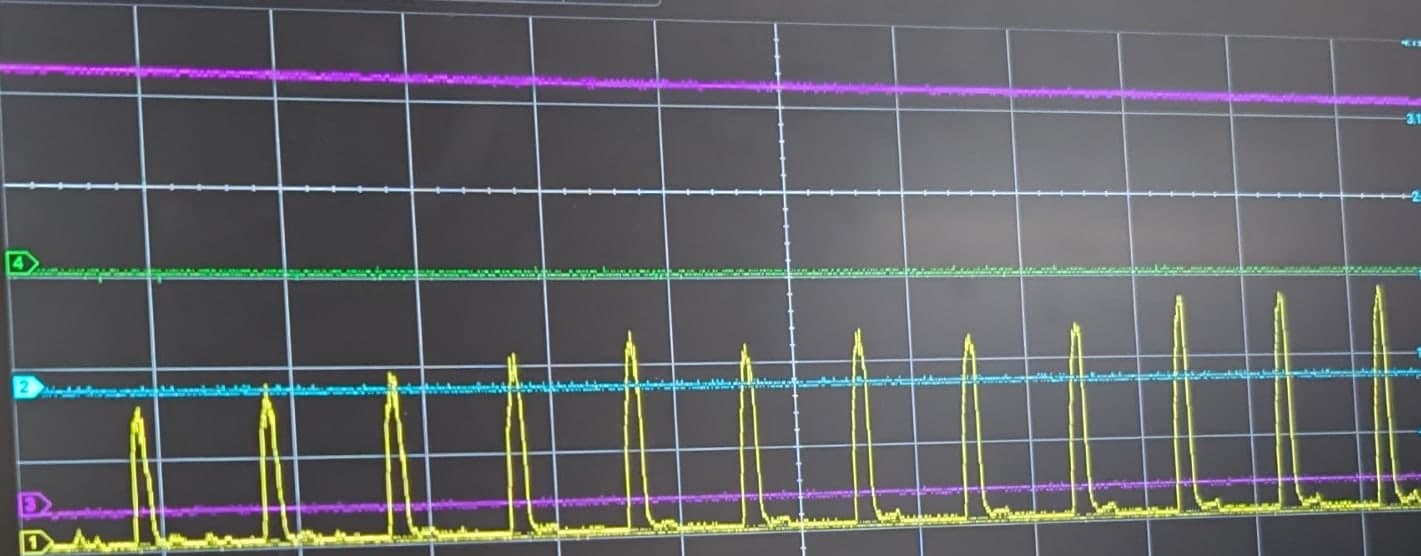
Reference: AMOS 2025 paper and SPIE 2026 invited paper (in press), listed under Publications.
4. Burst pumping, made possible by the instant lock
The obstacle. Diodes locked by a diffractive element take seconds to warm up to their locked wavelength, so they cannot pump in short bursts.
An atomic filter has no warm-up. The atoms define the wavelength, so the lock is present from the first instant of each burst. Refinements to the pump module now hold that lock at drive currents well above the diodes’ continuous rating, in short bursts separated by pauses for recovery. This is quasi-continuous-wave operation.
A given diode array then delivers much brighter bursts. For daytime lidar it is peak brightness, not average power, that sets sensitivity, and a low duty cycle keeps the diode count and the cost down.
Reference: SPIE 2026 invited paper (in press), listed under Publications.
Scaling
The amplifier assigns its three axes to gas flow, pump light and laser beam, so each can grow independently. Its geometry is the subject of U.S. Patents 11,855,406, 12,212,113 and 12,548,968. Average power scales mainly with the number of diodes on a fixed architecture. Continuous pumping, with a larger diode array in the same frame, is the other end of the same range, not a different machine.
What the laser is for is described under Missions.
Patents and published applications
Each number links to the full record on Google Patents.
| Number | Title | Inventors | Granted or published |
|---|---|---|---|
| US 12,548,968 | Gaseous laser systems with edge-defining element and related techniques | Hersman | February 10, 2026Granted |
| US 12,470,039 | System and techniques for diode laser wavelength spectrum narrowing | Distelbrink, Hersman, Ruset | November 11, 2025Granted |
| US 12,212,113 | Gaseous laser systems with edge-defining element and related techniques | Hersman | January 28, 2025Granted |
| US 11,855,406 | Gaseous laser systems with edge-defining element and related techniques | Hersman, Distelbrink | December 26, 2023Granted |
| US 2025/0237750 | System and techniques for discovery and tracking of objects in space | Hersman | July 24, 2025Published application |
- US 12,548,968
Gaseous laser systems with edge-defining element and related techniques
Hersman
February 10, 2026. Granted.
- US 12,470,039
System and techniques for diode laser wavelength spectrum narrowing
Distelbrink, Hersman, Ruset
November 11, 2025. Granted.
- US 12,212,113
Gaseous laser systems with edge-defining element and related techniques
Hersman
January 28, 2025. Granted.
- US 11,855,406
Gaseous laser systems with edge-defining element and related techniques
Hersman, Distelbrink
December 26, 2023. Granted.
- US 2025/0237750
System and techniques for discovery and tracking of objects in space
Hersman
July 24, 2025. Published application.