
Why DPAL
The diode-pumped alkali laser
The efficiency of diodes in the beam of a gas laser. Why the idea has drawn two decades of effort, how the choice of alkali shapes it, and what has held it back.
The idea
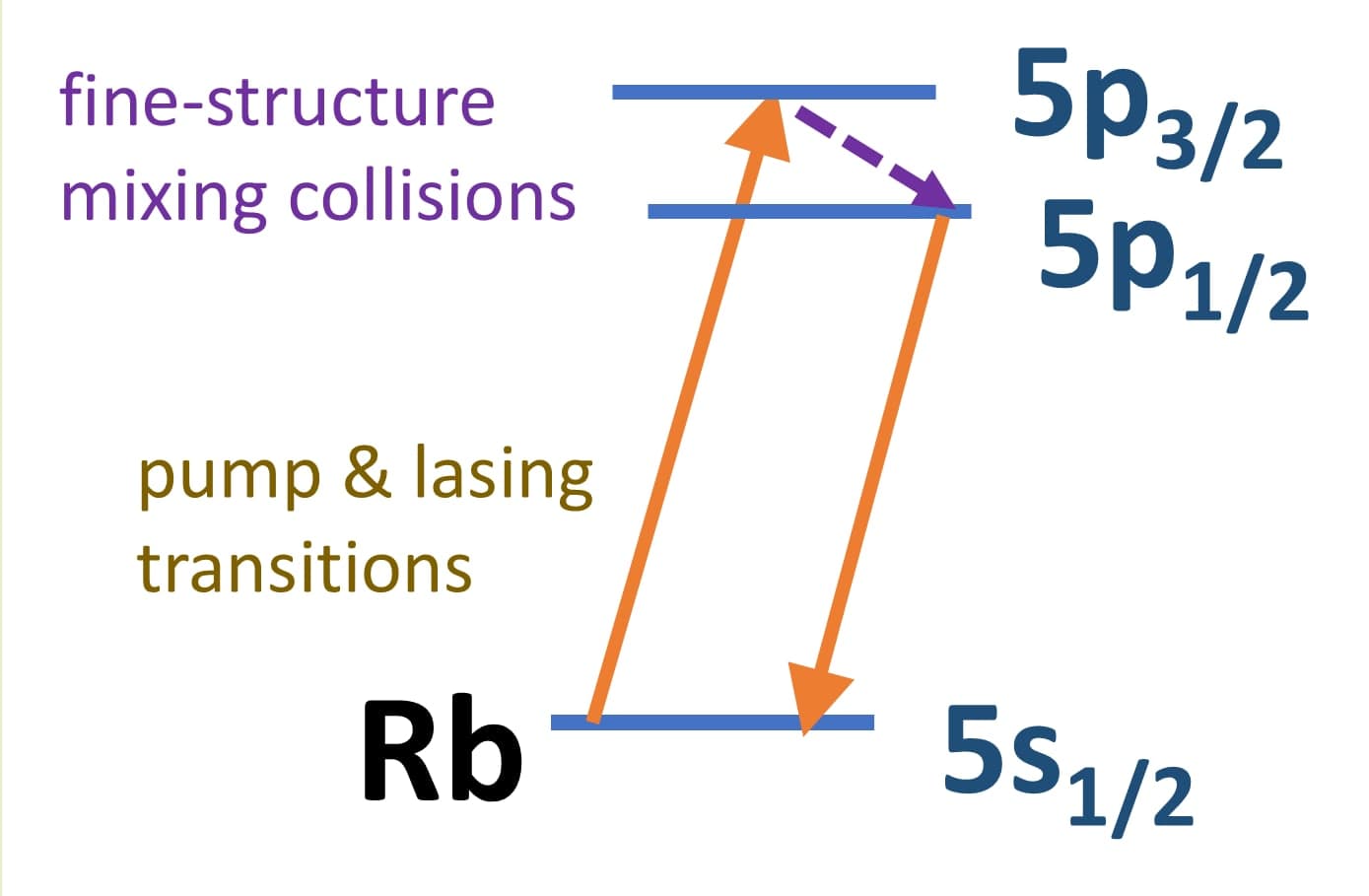
A diode-pumped alkali laser (DPAL) uses the vapor of an alkali metal as its gain medium. Laser diodes excite the atoms on one resonance line, the D2 line. Collisions with a buffer gas move the excited atoms to a level just below, and they lase on the neighboring D1 line. The light of many diodes, which cannot be focused well, goes in. A single beam of high quality comes out.
William Krupke and colleagues introduced the concept in 2003, using a titanium-sapphire laser in place of the diodes. Diode pumping followed by 2006.
Why it matters
- A quantum defect of a few percent. The pump photon and the laser photon differ in energy by 0.4 to 4.7 percent, depending on the alkali. In Nd:YAG pumped at 808 nm the difference is 24 percent, and in ytterbium fiber lasers it is about 9 percent. That difference is the least heat a laser can leave in its medium, so an alkali laser starts with far less heat to remove.
- No thermal lens. In a solid-state laser, heat stresses and deforms the crystal or fiber. That distorts the beam and sets the power limit. A gas has no stress, no birefringence and no fracture limit.
- The medium carries its own heat away. The gas flows. What heat is deposited leaves with it, and fresh gas takes its place. The beam cannot permanently damage a gas.
- A near-infrared wavelength. Alkali lasers emit between 770 and 895 nm, where the atmosphere transmits well. The wavelength is shorter than that of the one-micron solid-state sources, so a director of a given size forms a smaller spot: at 795 nm, about three-quarters the diameter, which is close to 1.8 times the intensity. The shorter wavelength also scatters somewhat more.
- One aperture. Power grows with the pumped volume and the number of diodes. The output remains a single beam from a single aperture, with no need to combine many lasers.
- Electric and closed-cycle. The laser runs on electricity and recirculates its gas. It consumes no chemical fuel.
- An atomic line. The output sits on an atomic resonance. A receiver fitted with a filter made from the same atom passes the laser’s light and rejects nearly all sunlight. Silicon detectors are also at their best at these wavelengths.
Choosing the alkali
Three alkali metals are in use. They differ in wavelength, in quantum defect, and in the gas needed to move atoms from the pumped level to the lasing level, a step called spin-orbit mixing.
| Alkali | Pump → laser | Quantum defect | Mixing gas |
|---|---|---|---|
| Potassium | 766 → 770 nm | 0.4% | Helium |
| Rubidium | 780 → 795 nm | 1.9% | A hydrocarbon at low pressure, or helium at high pressure |
| Cesium | 852 → 895 nm | 4.7% | A hydrocarbon |
Potassium
766 → 770 nm, quantum defect 0.4%
Mixing gas: helium
Rubidium
780 → 795 nm, quantum defect 1.9%
Mixing gas: a hydrocarbon at low pressure, or helium at high pressure
Cesium
852 → 895 nm, quantum defect 4.7%
Mixing gas: a hydrocarbon
Potassium has the smallest quantum defect and the shortest wavelength. Its two upper levels lie so close together that helium alone mixes them.
Cesium has the longest wavelength and the largest defect. Its levels lie far apart, and mixing them takes a hydrocarbon gas such as ethane.
Rubidium sits between the two. A hydrocarbon mixes its levels at low pressure, and helium does so at high pressure. LiDAR Space works with rubidium.
What has held it back
Surrogate pumps. The first alkali lasers were pumped by narrow-line laboratory lasers, titanium-sapphire and alexandrite among them. Those experiments showed that the step from pump light to laser light is efficient: more than half the pump light came out in the beam. But such lasers make their own light inefficiently. They prove the physics without making a practical system.
Diodes. Laser diodes make light efficiently and cheaply. Their natural linewidth, however, is about a thousand times wider than the absorption line of the atoms, so most of their light passes through the vapor unabsorbed.
Diffractive narrowing. Feedback from a diffractive element, such as a volume Bragg grating, narrows the diodes about tenfold. That still leaves them some hundred times wider than the atomic line. The customary remedy is to widen the atoms instead. Buffer gas at several atmospheres broadens the absorption line, and a higher alkali density, which means a higher temperature, absorbs the light that falls in the wings.
The price of pressure. Broadening lowers the peak absorption, so the cell must run hotter and denser, and the loss processes that grow with density and temperature take a larger share. The pressure that broadens the line also shifts it, and with it the laser’s output line. In some cases the shifted output falls on an absorption line of the atmosphere. A shifted line also no longer matches an atomic filter at the receiver.
Pulses. Two further obstacles concern pulsed operation. Diodes locked by a diffractive element take seconds to warm up to their locked wavelength, which rules out pumping in short bursts. And an excited alkali atom holds its energy for about thirty nanoseconds, so the medium cannot store energy between pulses as a solid-state laser does. Alkali lasers have therefore been continuous-wave machines.
Our work takes these obstacles in turn. It is described under Technology.